
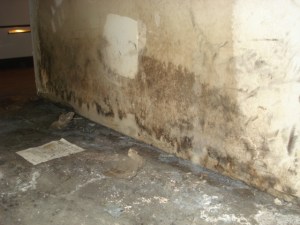
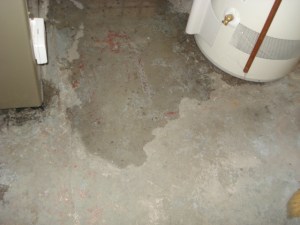
This time of year in the summer months causes concerns for musty odors, excess moisture and mold growth on the surfaces. What’s that smell? Do you know what is going on down in your crawlspace? Does it have a dirt floor? Is the open fiberglass insulation in the floor joist drooped down into the floor? These are signs that excessive moisture, musty odors and dampness, and mold contamination growth may be occurring.
Mold spores can and will exacerbate with any excess moisture and excess relative humidity that will cause existing mold spores to travel and move around where new growth can occur. Excess relative humidity in a basement or crawlspace is like adding ‘gas onto the fire’ where mold spores will grow.
Conducting a thorough visual investigation of the musty odor or any source of water leak, excess moisture is very important. Relative humidity (RH) should be less than 60% or lower to help to control moisture 30% to 50% (RH) is the best range). When (RH) is above 60% or more this is not good for your basement, crawlspace, or living/working space where mold and other contaminants can grow; even causing wood rot and decay to the structural support of the wood beams and joists. To control excess moisture and humidity it is important to install the proper dehumidification system. Too often homeowners and business owners do not have the proper size dehumidifier(s) installed because the square footage or cubic area is too large and the unit does not cover this amount of ambient space.
Crawlspaces with dirt floors should have quality grade vapor barriers with minimal 6 Mil thicknesses or higher covering the entire dirt floor including part of the lower side walls or to the top. Quality grade dehumidification is recommended to help control moisture.
During the hot and humid months less moisture is probable when the outside vents of crawlspace are closed up. Climates are different throughout the country; the Northeast region is different from the Southeast and Southwest regions.
Insulate using foam pipe sleeves any copper pipes underneath the crawlspace or in the basement area. The cold water pipes usually condensate when excess humidity comes in contact with them. Insulate Well Tanks and Water Filter Tanks as well. Dehumidifiers need to drain properly operating on a 24/7basis when needed.
If chronic water leaks or water floods into the basement or crawlspace areas then quality grade sump pump(s) and/or drainage are recommended. Install vinyl grade cover over sump pump area. Sump pump is best installed in the ground and the bucket is deep enough to effectively pump and drain water. Add drainage around perimeter if necessary. A professional can provide the proper assessment with the proper tools to help to determine such factors as relative humidity, temperature, air flows, moisture meters, boroscope camera, Thermal Infrared camera etc.
Environmental Resources is here to help identify problem areas. Also we provide solutions with products and quality air purification with several pounds of carbon to fight odors. We offer sampling if it is called upon. Call for a professional consultation of your home or business for indoor air quality today. Serving South Shore Plymouth county, Barnstable county Cape Cod and Martha’s Vineyard Boston and Metro West, Norfolk County, Suffolk County, of Massachusetts.
Andy Provitola CMC-Certified Microbial Consultant
Environmental Resources LLC
Pembroke, MA 02359
781-248-9975
 Healthy Indoor Air Quality